

The Ghost in the Machine: On Trust, Truth, and Thriving in the New Age of AI
The map is being redrawn while we're still on the journey. For decades, businesses navigated the digital landscape with Google as their compass, mastering Search Engine Optimisation (SEO) to rank on pages of blue links. Then, almost overnight, the landscape began to speak.
Artificial Intelligence, in the form of Large Language Models like ChatGPT, is no longer a passive tool—it's an active participant in the customer experience, fundamentally reshaping how customers discover brands. This is the shift from finding to being recommended, and it changes everything about business strategy and brand visibility.
In this thought leadership piece, I explore why AI Optimisation (AIO) and Generative Engine Optimisation (GEO) are replacing traditional SEO, introduce the new trinity of performance metrics, and reveal why "Heart-Led Marketing" is the only sustainable path forward.
By Mimi Glenn, Fractional CMO & Business Strategist

A thought leadership piece for founders, leaders, and the perpetually curious. Fully optimised for SEO, AIO, and GEO to maximise reach and engagement.
Have you ever had the feeling the map is being redrawn while you’re still on the journey? I see it in the eyes of the founders I work with almost every day. For decades, we charted our course through the digital landscape with a familiar compass. Google was magnetic north, SEO was our sextant, and we became masters of that particular terrain. We learned its contours, its hidden paths, its subtle dialects of keywords and backlinks. We built our commercial empires on its predictable geology.
And then, almost overnight, the landscape began to speak.
The End of the Search and the Dawn of the Conversation
We are at the precipice of a profound shift in how business works, a pivotal moment in digital transformation. The era of the search query—that staccato burst of intent fired into a void; is giving way to the age of the conversation. Artificial Intelligence, in the form of Large Language Models (LLMs) like ChatGPT, is no longer a passive tool for information retrieval; it is an active participant in the customer experience, shaping discovery and decision making. It is the new oracle, the digital confidante, the ghost in the machine that is fundamentally reshaping how your customers find you, or if they find you at all.
This is not merely a technological evolution; it is a philosophical one: We are moving from a paradigm of finding to a paradigm of being recommended. And this, I believe, changes everything.
From SEO to AIO: A Redefinition of Visibility
Our obsession with ranking on a page of blue links is rapidly becoming a quaint anachronism. The new imperative is not to be found, but to be known by the machine. This has given rise to two new, interconnected disciplines:
•Generative Engine Optimisation (GEO): This is the tactical layer, the craft of shaping your content so that it is favourably interpreted and presented by generative AI models. It is the direct successor to SEO, focused on the mechanics of AI-driven responses.
•AI Optimisation (AIO): This is the strategic layer. AIO is a more holistic philosophy that encompasses not just how your content is written, but how your business structures its data, defines its truth, and builds its reputation for an AI-first world. It is less about gaming an algorithm and more about teaching an intelligence.
Aspect
The Old World (SEO)
The New Reality (AIO/GEO)
The Goal
To rank on a results page
To be the trusted answer in a conversation
The Language
Keywords and backlinks
Clarity, context, and structured truth
The Audience
A human scanning a list
An AI synthesising a definitive response
The Metric
Click-through rate
Influence and accuracy
To optimise for AI is to engage in an act of profound corporate clarity. It demands that we distil our brand, our products, and our services into their most truthful, unambiguous essence. The AI, you see, has little time for marketing fluff; it craves structured data, verifiable claims, and a clear, coherent narrative.
The Conversational Marketplace: Commerce Within the Chat
The line between conversation and transaction is dissolving. This is the new frontier of conversational commerce: A purchase is no longer a destination one travels to after a search; it is an integrated function of the dialogue itself. A customer can now articulate a need, receive a recommendation, and complete a purchase within a single, seamless interaction.
For businesses, this presents both a tantalising opportunity and an existential threat. It is a new, direct channel to millions of consumers, yet it is a channel mediated by an intelligence whose biases and preferences we are only just beginning to understand. To be absent from this conversation is to risk becoming invisible in the new marketplace.
Measuring the Unseen: The New Trinity of Performance
Our old metrics are failing us: Pageviews, bounce rates, and session durations are relics of a world where the journey mattered more than the destination. In an age where the AI can provide a complete answer without a single click, we must learn to measure the unseen. This requires a new framework for AI-driven marketing.
I propose a new trinity of performance indicators for this new age:
1.AI Signal Rate (The Measure of Presence): How frequently is your brand mentioned when the AI responds to relevant queries? This is the new benchmark for brand visibility. It is not about being on the list; it is about being part of the answer.
2.Answer Accuracy Rate (The Measure of Truth): When your brand is mentioned, is the information correct? Does it align with your core values and messaging? This is the new frontier of reputation management. Visibility without truth is a liability.
3.AI-Influenced Conversion Rate (The Measure of Trust): Of the customers who are influenced by an AI recommendation, how many choose you? This is the ultimate metric, connecting your presence in the machine to the health of your balance sheet.
The Path Forward: A Mandate for Heart-Led Clarity
How, then, do we navigate this new world? The answer, I believe, lies not in more complex technology, but in a more profound humanity. It requires what I call Heart-Led Marketing: the practice of infusing every aspect of your business with such clarity, authenticity, and integrity that the machine cannot help but reflect your truth.
1.Build Your Canon: You must define, with absolute precision, the core truths of your brand. Your mission, your values, your product specifications, your service promises. This is your ‘Brand Canon’—the source of truth against which the AI’s understanding will be measured. This is the foundational document for your entire AIO strategy.
2.Speak in Structure: Embrace structured data and schema markup as your new corporate language. This is how you teach the AI, providing it with a clear, unambiguous framework for understanding who you are and what you do. Think of it as creating the syllabus for the AI's education about your business.
3.Cultivate Your Garden: Your website is no longer just a digital storefront; it is a knowledge base for the AI. Fill it with rich, in-depth content that demonstrates your expertise, authority, and trustworthiness. The machine is learning from what you publish; give it a world-class education.
We stand at a crossroads. We can view this new intelligence as an adversary to be manipulated, or as a partner to be educated. I believe the latter path is the only one that leads to sustainable success. The future of commerce will not be won by those who are best at gaming the system, but by those who are most committed to telling the truth, beautifully and clearly. The ghost in the machine is, after all, a reflection of ourselves. It is our responsibility to ensure it has a worthy subject to reflect.
Frequently Asked Questions (FAQ)
-
A1: SEO (Search Engine Optimisation) focuses on ranking in traditional search engines like Google. GEO (Generative Engine Optimisation) is the tactical process of optimising content for AI-generated answers. AIO (AI Optimisation) is the overarching strategy of structuring your entire business; its data, content, and reputation, to be understood and trusted by AI models.
-
A2: Start by creating a "Brand Canon"; a single source of truth for your company's core information. Then, ensure your website content is clear, accurate, and well-structured. Finally, begin tracking your "AI Signal Rate" for a few key industry questions to see if you are appearing in AI answers.
-
DA3: Keywords are less important than context and clarity. Instead of focusing on specific keywords, focus on answering customer questions comprehensively and authoritatively. AIO prioritises natural language and semantic relevance over keyword density.
-
A4: Trust. Both AI models and the humans who use them are looking for trustworthy, accurate, and reliable information. Building a brand that is demonstrably truthful and authoritative is the most critical long-term strategy for success in the AI era.

The Psychology of Brand Trust in 2025: How to Win Customers in an AI-Driven World
Discover the psychology behind brand trust in 2025. Learn how brands like Pearl Yachts, SmartEducator, and Nicole Wright Fitness build trust through consistency, tone, responsiveness, and proof; even in an AI-automated world.t all begins with an idea.
Why Trust is the Ultimate Marketing Strategy in 2025
In a world of AI-generated content, automated funnels, and endless digital noise, one thing hasn’t changed:
People buy from brands they trust.
It doesn’t matter whether you’re selling:
A £4 million yacht,
An AI platform for education,
A compliance automation tool,
Or a premium fitness coaching programme...
Trust is the currency that converts.
This article explores the psychology of brand trust in the digital era; with real world examples from brands I have worked with (all with very different clients) Pearl Yachts, SmartEducator, SmartAssessor, and Nicole Wright Fitness. Whether you're in B2B, B2C, or a hybrid model, these strategies apply.
What Builds Brand Trust? (Backed by Psychology)
Psychology tells us that trust forms when customers feel:
✔️ Safe: Financially, emotionally, and reputationally.
✔️ Seen: Understood, respected, and recognised.
✔️ Certain: Confident that promises will be kept.
This applies universally; whether you’re selling products, services, experiences, or technology.
The 5 Psychological Pillars of Brand Trust
1. Consistency Equals Safety
People trust what feels familiar. Consistency in branding, tone, and delivery reassures customers that your brand is stable, professional, and reliable.
Pearl Yachts maintains visual and tonal consistency with luxury cues; elegant design, understated messaging, and timeless photography. No gimmicks, no hype; just craftsmanship and confidence.
SmartEducator adapts tone between teachers (empathetic, supportive) and schools (formal, data secure), yet the underlying brand voice stays consistent: helpful, reliable, and trustworthy.
SmartAssessor delivers a rock-solid professional presence with clear messaging around compliance, security, and automation reliability; essential in regulated industries.
Nicole Wright Fitness shows up daily with consistent messaging: strength, freedom, confidence; never veering into diet culture gimmicks.
SEO Tip: Consistency improves brand recall, increases engagement, and reduces bounce rates; factors that indirectly improve SEO.
2. Speed and Responsiveness = Reliability
Fast, human responses signal professionalism and care. Whether through email, DMs, or customer support; speed builds trust.
Pearl’s luxury clients expect discreet, immediate communication. Silence breaks million; pound deals.
SmartAssessor’s clients rely on rapid answers about compliance and integration; slow replies cause doubt.
Nicole’s clients message with concerns or questions and know they’ll be heard quickly. That responsiveness is part of her brand value.
SmartEducator’s demo and support teams understand: speed equals confidence.
SEO Connection: Fast-loading websites, live chat responsiveness, and quick contact form replies improve both trust and search rankings.
3. Tone of Voice: The Instant Trust Signal
Your tone of voice tells people whether you’re credible, relatable, or risky.
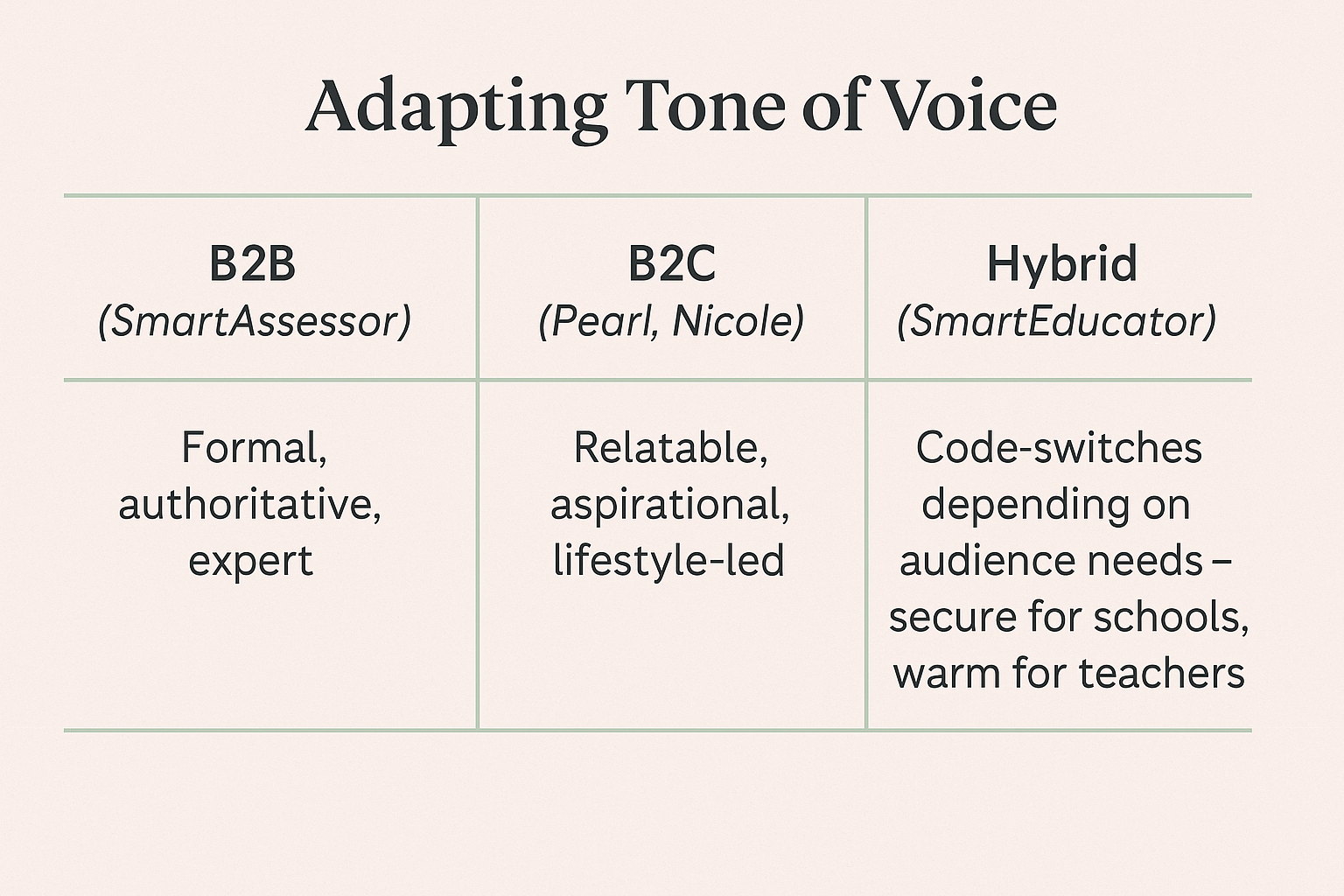
B2B (SmartAssessor)B2C (Pearl, Nicole)Hybrid (SmartEducator)Formal, authoritative, expertRelatable, aspirational, lifestyle-ledCode-switches depending on audience needs; secure for schools, warm for teachers
Pearl Yachts uses elegant, calm language: “Crafted for timeless journeys.” No shouting.
SmartAssessor speaks the language of compliance and operational reliability: “Automate certifications. Ensure compliance. Reduce admin.”
Nicole Wright Fitness communicates with calm empowerment: “Build a body you trust.” Not “Get shredded fast.”
SmartEducator balances: reassuring to teachers (“Save time. Stay consistent.”) and formal to school leaders (“ISO 27001 certified. GDPR compliant.”).
SEO Angle: Consistent tone reduces bounce rates and boosts conversion, signalling relevance to Google.
4. Visibility and Repetition = Reinforced Trust
Trust isn’t built in a single post. It’s the result of showing up; reliably, repeatedly.
Weekly newsletters.
Regular social posts.
Updated websites.
Ongoing email nurture.
Humans trust patterns. If you go dark for weeks or months, the subconscious assumption is: “They’re unreliable.”
5. Proof Over Promises
Nothing builds trust like proof. Claims are cheap. Evidence converts.
Pearl Yachts uses client referrals, yacht shows, and prestigious media features.
SmartAssessor offers case studies: “Saved 40 admin hours monthly and improved audit outcomes.”
SmartEducator shares stats like “Saved teachers 8 hours per week” and testimonials from schools.
Nicole Wright Fitness posts client wins framed around mental and physical strength; not shame or gimmicks.
SEO Note: Testimonials, case studies, and reviews improve page dwell time and trust signals to both users and search engines.
B2B vs. B2C: How Trust Is Built Differently

.
B2B (SmartAssessor)B2C (Pearl, Nicole)Hybrid (SmartEducator)✔️ Risk = Financial, Operational, Compliance✔️ Risk = Emotional, Financial, Identity✔️ Needs both lenses✔️ Trust built on process integrity, security, compliance✔️ Trust built on empathy, lifestyle alignment, and social proof✔️ Requires both✔️ Tone: Formal, authoritative✔️ Tone: Conversational, empowering✔️ Flexible while consistent
The Hidden Threat in 2025:
Automation without humanity.
If your customer experience becomes a faceless string of auto-responses, chatbots, and AI-generated fluff; you erode trust.
People don’t buy from systems. They buy from brands that feel like people.
Checklist: How to Build Brand Trust Today
Consistent branding, tone, and experience
Fast, human responsiveness
Copy that mirrors real customer fears, hopes, and language
Reliable presence (newsletters, content, updates)
Proof: case studies, reviews, testimonials woven into marketing
Conclusion: Trust Is the New Growth Strategy
In an AI-driven, noisy world, trust becomes the loudest signal.
If someone’s buying a yacht, an edtech tool, or a fitness transformation; they are not buying features.
They’re buying certainty. Safety. A future version of themselves they trust…They are investing in the way your brand makes them feel.
Trust isn’t a checkbox. It’s a strategy. A feeling. An outcome of every word, every reply, every experience.